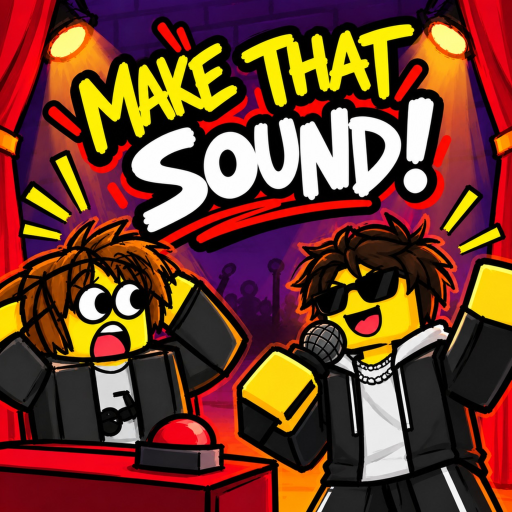
The performer
The player whose turn it is to recreate the sound. Your job is accuracy first: commit to one interpretation of the prompt instead of hedging between two sounds halfway through.
Everyone takes this seat in rotation.
Make That Sound! is a head-to-head party game in 8-player servers, judged by live player rating — so squad planning is session planning: who plays, what the room rewards, and what the session is for. Built from documented facts, checked 2026-10-23.
In most Roblox games a squad is a loadout problem; here it is a room problem. Every round, one player performs the mystery sound and up to seven others rate it live — and the official description makes the social loop the product: "Challenge your friends, compete head-to-head, and see who has the best ears." That gives a squad exactly three levers, all documented: arrive prepared (microphone and Voice Chat are hard requirements), fill the round roles well (a committed performer, honest raters), and set a session goal that matches the squad's stage. The planner below turns those into a checklist and two worked sessions.
No classes, no units — these are the seats the game's own rules create.
The player whose turn it is to recreate the sound. Your job is accuracy first: commit to one interpretation of the prompt instead of hedging between two sounds halfway through.
Everyone takes this seat in rotation.
The rest of the server rates performances live. Ratings decide scores, so a squad that knows each other's humor and references rates more consistently than strangers do.
Up to 7 other players in an 8-player server.
Friends who join the same server turn the rating stage into a fair, familiar room. The official description explicitly sells the game as 'challenge your friends' — the squad is a feature, not a mode.
Coordinate outside the game, then join the same server.
Every item traces to a documented system — nothing here assumes an unpublished mechanic.
Clear the two published gates first: a microphone and Roblox Voice Chat on an age-checked 13+ account. Then do the undramatic stuff that decides rounds — a quiet room, mic at a consistent distance, and your audio level tested once.
One goal per session keeps a squad engaged: learning the round rhythm on a first night, protecting a win streak, or farming Coins toward a mic. Mixing three goals mid-session is how sessions dissolve.
Listen fully before you speak; identify the sound's category (voice, object, animal, meme) out loud if it helps; commit to the impression; keep the reproduction short and paced rather than loud.
Watch what the room rewards. Live player rating means reading the room is a real skill: the same performance style will land differently in different servers, and adapting between rounds is faster than practicing in isolation.
If the group has posted a code, redeem it before playing — the balance arrives immediately and the documented redemption path (the CODES button on the right side of the screen) takes seconds.
Adapt the scripts to your roster — the structure is what transfers.
Everyone clears Voice Chat and the mic check before queueing, joins the same public server (Make That Sound! servers hold 8 players, and VIP server creation is disabled on the game page), and plays the first sessions for exposure rather than score: the goal is hearing enough prompts to learn the game's pacing. Expect the score to be noisy at first — you are being rated by strangers.
Lesson: Treat night one as catalog exposure, not a leaderboard attempt.
A squad that already wins rounds switches the goal to streak protection: the strongest impressionist takes prompts in their strongest categories first, the squad rates honestly to keep the room fair, and anyone who must leave signs off between rounds rather than abandoning one mid-rating. No public source documents how streaks break, so the safe doctrine is never to test it on purpose.
Lesson: Because streak rules are undocumented, protect the streak conservatively.
Three common squad-planning features that no checked source documents for this game, as of 2026-10-23.
No public source documents private matches, and the Roblox games API reports VIP server creation as disabled for this experience. Squad sessions run in public servers of 8.
The official page names score, win streaks, stats, and leaderboards — all individual surfaces. No documented mechanic rewards playing adjacent to friends beyond the room you make.
Win streaks exist and matter, but their break conditions are undocumented. The safe doctrine is conservative: protect a streak rather than testing how it ends.
Servers hold 8 players (official Roblox page, checked 2026-10-03), so a full squad is you plus seven. In practice the plan works the same at any size: everyone joins the same public server, because the game page does not offer VIP server creation and there is no documented private-match mode.
Not units or classes — the documented roles are round roles. Each round, one player is the performer recreating the mystery sound and the rest of the server rates live. A squad's job is to make both seats work: take your turn seriously, and rate honestly so scores mean something.
Coordinate outside the game, launch from the official Roblox page at the same time, and join each other from the in-game player list. The official description explicitly sells head-to-head play with friends, so the flow is supported — it just runs through public servers rather than a lobby invite system documented anywhere public.
Exposure, not score. The sound catalog is unpublished and grows with updates, so the first sessions are where everyone learns the prompt pacing and the room's rating style. Chasing a streak on night one measures luck, not the squad.
No — and that is official. The game description requires both a microphone and Roblox Voice Chat to compete, and Voice Chat itself requires an age-checked 13+ account in a supported region. Clear both gates before the session; the microphone check page walks through them.
Gate one of the checklist, step by step.
The listen-recreate-compete loop in detail.
What the round results feed into.
Your vocal setup — the closest thing to a build.
The Coins your sessions earn, honestly bounded.
The first-session route new squadmates should run.
Server size, requirements, and the rating loop above come from the official Roblox page and games API (2026-10-23); see the sources register for the full list.